📖 Learn Arabic to Understand the Quran — It's Easier Than English
🧭 Arabic Grammar is not a Maze, it's a Map
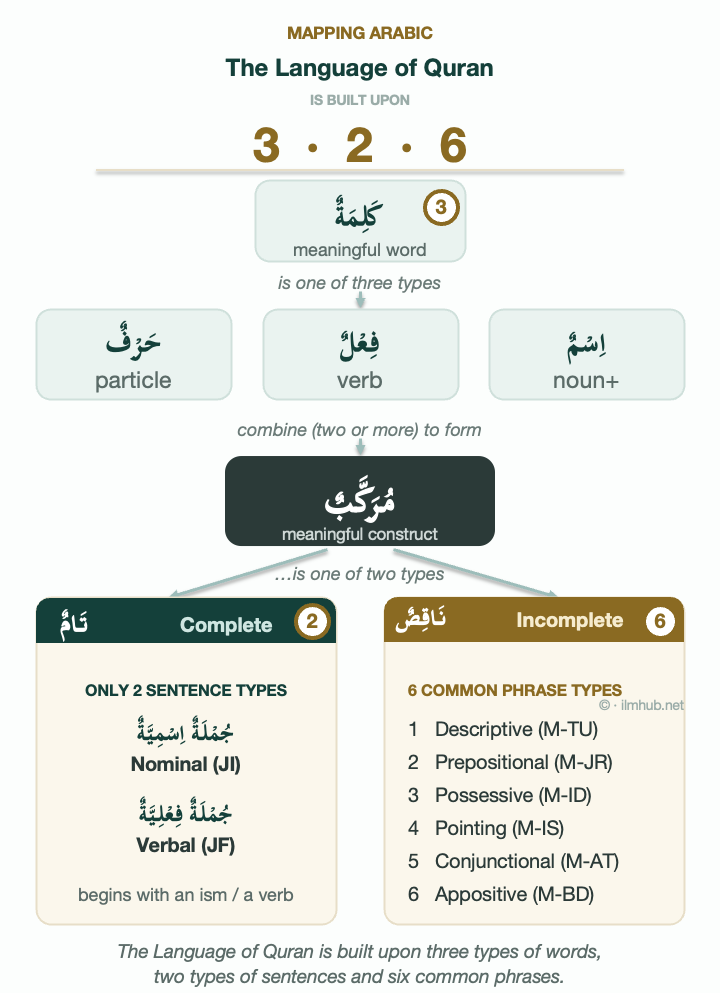
🗺️ Mapping Arabic
Understand your learning journey through a simple visual roadmap.
🔤 Three types of Arabic words
Learn ism, fi‘l, and harf, and how they combine to form meaning.
🧩 Six essential phrase types
Recognise key building blocks that appear throughout Qur’anic Arabic.
🏗️ The two types of Arabic sentences
Understand how Arabic sentences are built and how they complete meaning.
📖 Essential Qur’anic vocabulary
Learn high-frequency words that appear again and again in the Quran.
🎓 What You’ll Learn
Where will the course take you
Introduction · Mapping Arabic — 3-2-6, the map not the maze
You can read the Quran. So how do you go from reading it to understanding its meaning and message in Arabic? This introductory lesson gives you the whole language on a single map, so that from your very first lesson you know where you are, where you are going, and why each step follows the one before.
Allah has made the Quran easy. Arabic is not a maze to get lost in — it is a clear map that leads from reading to understanding. Follow it consistently, and before long the ayat begin to open.
- Arabic as one connected system — three types of word, two types of sentence, six essential phrases — so nothing you meet later arrives out of nowhere
- Every Arabic word is one of three types, with no fourth — and knowing which type a word is, is what lets you learn the rules that shape phrases and sentences
- Not a list to memorise — this is not a list of words to memorise, nor a set of videos to watch; instead you stop collecting material and start building understanding
- Build on reading — Arabic is within your reach precisely because you can already read it; your recitation becomes the foundation you build on
- Understand structure — an ayah is built up of sentences and phrases, not a list of words only, so you know what you are actually trying to understand
- Surah Al‑Fatihah, mapped — watch the whole system at work in a surah you already know by heart
Allah has made the Quran easy. Arabic is not a maze to get lost in — it is a clear map that leads from reading to understanding. Follow it consistently, and before long the ayat begin to open.
Unit One · The Word — the ism and its four properties
Our focus now is the ism — one of the three types of word, and by far the most common in the Qur'an. Every ism carries four properties, and recognising all four is what allows you to use it. You are never simply told what the properties are: you see them working inside real phrases and sentences from the first lesson, and you build your own. By the end of this unit you are reading Arabic sentences, not decoding words.
By the end of this unit you recognise thousands of Qur'anic words on sight, read the two structures Arabic is built on, and stand on solid ground for the six phrases.
- The four properties of any ism — Definiteness, Gender, Number and I'raab — through the DiGNI system, so you read all four straight off the word itself
- The shapes of the Muslim Table — so over 23,000 words of the Qur'an become recognisable from their pattern alone
- The detached pronouns — a short list that hands you words appearing more than 1,300 times in the Qur'an
- The nominal sentence — so you build and read your first complete Arabic sentences
- The descriptive phrase, with every property agreeing — so one of the six phrases is already yours
- The move from word level to phrase and sentence level — so you reach Unit Two ready to build, not ready to start
By the end of this unit you recognise thousands of Qur'anic words on sight, read the two structures Arabic is built on, and stand on solid ground for the six phrases.
Unit Two · The Phrases — the six structures that carry the meaning
Words carry meaning. Structures carry the message.
Every incomplete construct in Arabic — every group of words that means something without yet making a complete statement — is one of just six types. This unit gives you all six, so that you stop reading a line as separate words and start reading it as the shape the Qur'an actually uses.
The prepositional and possessive phrases alone appear in 89% of the Qur'an's ayat. Take all six together and they appear in more than nine out of every ten — two or three of them in every line of the mushaf.
Every incomplete construct in Arabic — every group of words that means something without yet making a complete statement — is one of just six types. This unit gives you all six, so that you stop reading a line as separate words and start reading it as the shape the Qur'an actually uses.
- All six phrase types, recognisable on sight — so you can name what you are looking at anywhere in an ayah
- The prepositional phrase, the commonest of them all — so you can read a structure that appears in four out of every five ayat and accounts for about one word in six
- The possessive phrase, and the chains where one runs straight into the next — so "Master of the Day of Judgement" resolves instead of stalling
- Pronouns attached to a phrase — so the forms you meet constantly stop being obstacles
- Phrases combined, with the agreement chain held — so longer structures stay readable
- Real Quranic ayat — so you begin translating meaningful portions of the text itself
The prepositional and possessive phrases alone appear in 89% of the Qur'an's ayat. Take all six together and they appear in more than nine out of every ten — two or three of them in every line of the mushaf.
Unit Three · The Sentence — from phrases to complete Quranic Arabic
Everything now comes together. The phrases you can read sit inside sentences, and sentences are what an ayah is made of. This unit takes you from handling structures in isolation to following a complete ayah from beginning to end.
- The two types of Arabic sentence, told apart on sight — so you know what an ayah is doing before you translate a word of it
- The nominal sentence in its fuller and less obvious forms — so the ones that used to defeat you no longer do
- The key components of the verbal sentence — so the structure behind the great majority of ayat becomes readable
- A complete ayah, followed part by part — so understanding replaces guessing
- Accurate translation into natural English — so what you understand, you can also express
- The foundation for Book Two — so you finish ready to continue, a new begining
🧠 How You Will Learn

🎯 Smarter Quizzes and Active Learning
👥 Who This Course Is For
This course is designed for English-speaking Muslims who can read Quranic Arabic but want to begin understanding what they read and recite.
👥 This course is ideal for:
⏳ Busy Muslims
Study through short, manageable sessions without having to attend classes at a fixed time.
📖 Those who want to understand the Qur’an
Study through short, manageable sessions without having to attend classes at a fixed time.
📖 Those who want to understand the Qur’an
Move beyond recitation and begin recognising Quranic words, phrases and sentence structures.
🏠 Learners unable to travel for study
🏠 Learners unable to travel for study
Follow a guided course from home, wherever you live, with all your learning resources organised in one place.
🔁 Students who have tried Arabic before
🔁 Students who have tried Arabic before
Begin again with a clearer structure, especially if previous courses felt confusing, too technical or disconnected from the Quran.
Allah Has Made it Easy

The Prophet (ﷺ) said:

This course was designed to help you learn with clarity:
MEET THE AUTHOR
Ustadh Muhammad Arjan Ali
Ustadh Arjan Ali is dedicated to making the Arabic of the Qur’an and daily prayer simple, clear, spiritually uplifting, and deeply meaningful for English-speaking students.
This course draws on years of personal teaching experience, refined through real classroom practice, with a focus on understanding the Qur’an directly in its original language.
Ustadh Arjan’s mission is simple: to remove confusion and make the Arabic of the Qur’an truly accessible — word by word, phrase by phrase, heart to heart.

Copyright © 2026
Created with